Timing comparisons with lacosmic and astroscrappy
In this notebook, we compare dfcosmic (both CPU and GPU implementations) with lacosmic and astroscrappy.
These tests were run using a System76 Adder WS with a Intel® Core™ i9-14900HX × 32 and a NVIDIA GeForce RTX 4060 Laptop GPU.
The code snippet for generating fake data was taken directly from astroscrappy tests; therefore, we thank them.
The fake data is set to have the approximate size as a standard narrowband observation taken with Mothra (6000 x 4000).
[1]:
import time
import torch
import numpy as np
from lacosmic.core import lacosmic
from astroscrappy import detect_cosmics
from dfcosmic import lacosmic as df_lacosmic
from threadpoolctl import threadpool_limits
import matplotlib.pyplot as plt
[2]:
num_threads = [1, 2, 4, 8, 16]
[3]:
# Make a simple Gaussian function for testing purposes
def gaussian(image_shape, x0, y0, brightness, fwhm):
    x = np.arange(image_shape[1])
    y = np.arange(image_shape[0])
    x2d, y2d = np.meshgrid(x, y)

    sig = fwhm / 2.35482

    normfactor = brightness / 2.0 / np.pi * sig**-2.0
    exponent = -0.5 * sig**-2.0
    exponent *= (x2d - x0) ** 2.0 + (y2d - y0) ** 2.0

    return normfactor * np.exp(exponent)


def make_fake_data(size=(6000, 4000)):
    """
    Generate fake data that can be used to test the detection and cleaning algorithms

    Returns
    -------
    imdata : numpy float array
        Fake Image data
    crmask : numpy boolean array
        Boolean mask of locations of injected cosmic rays
    """
    # Set a seed so that the tests are repeatable
    np.random.seed(200)

    # Create a simulated image to use in our tests
    imdata = np.zeros(size, dtype=np.float32)

    # Add sky and sky noise
    imdata += 200

    psf_sigma = 3.5

    # Add some fake sources
    for i in range(100):
        x = np.random.uniform(low=0.0, high=1001)
        y = np.random.uniform(low=0.0, high=1001)
        brightness = np.random.uniform(low=1000.0, high=30000.0)
        imdata += gaussian(imdata.shape, x, y, brightness, psf_sigma)

    # Add the poisson noise
    imdata = np.float32(np.random.poisson(imdata))

    # Add readnoise
    imdata += np.random.normal(0.0, 10.0, size=size)

    # Add 100 fake cosmic rays
    cr_x = np.random.randint(low=5, high=995, size=100)
    cr_y = np.random.randint(low=5, high=995, size=100)

    cr_brightnesses = np.random.uniform(low=1000.0, high=30000.0, size=100)

    imdata[cr_y, cr_x] += cr_brightnesses
    imdata = imdata.astype("f4")

    # Make a mask where the detected cosmic rays should be
    crmask = np.zeros(size, dtype=bool)
    crmask[cr_y, cr_x] = True
    return imdata, crmask
[4]:
# Make fake data
imdata, expected_crmask = make_fake_data()
Run the code using our four options:
dfcosmicon the CPUdfcosmicon the GPUastroscrappywithsepmed=Trueastroscrappywithsepmed=Falselacosmic
Option 1: dfcosmic on the CPU
[5]:
dfcosmic_cpu = []
for n_threads in num_threads:
    torch.set_num_threads(n_threads)
    start_dfcosmic_cpu = time.perf_counter()
    clean, crmask = df_lacosmic(
        image=imdata,
        objlim=2,
        sigfrac=1,
        sigclip=6,
        gain=1,
        readnoise=10,
        niter=1,
        device="cpu",
    )

    elapsed_dfcosmic_cpu = time.perf_counter() - start_dfcosmic_cpu
    dfcosmic_cpu.append(elapsed_dfcosmic_cpu)
[6]:
dfcosmic_cpu_torch_only = []

for n_threads in num_threads:
    torch.set_num_threads(n_threads)
    start_dfcosmic_cpu_torch_only = time.perf_counter()
    clean, crmask = df_lacosmic(
        image=imdata,
        objlim=2,
        sigfrac=1,
        sigclip=6,
        gain=1,
        readnoise=10,
        niter=1,
        device="cpu",
        use_cpp=False,
    )

    elapsed_dfcosmic_cpu_torch_only = (
        time.perf_counter() - start_dfcosmic_cpu_torch_only
    )
    dfcosmic_cpu_torch_only.append(elapsed_dfcosmic_cpu_torch_only)
Option 2: dfcosmic on the GPU
[7]:
dfcosmic_gpu = []
for n_threads in num_threads:
    torch.set_num_threads(n_threads)
    start_dfcosmic_gpu = time.perf_counter()
    clean, crmask = df_lacosmic(
        image=imdata,
        objlim=2,
        sigfrac=1,
        sigclip=6,
        gain=1,
        readnoise=10,
        niter=1,
        device="cuda",
    )

    elapsed_dfcosmic_gpu = time.perf_counter() - start_dfcosmic_gpu
    dfcosmic_gpu.append(elapsed_dfcosmic_gpu)
Option 3: Astroscrappy with sepmed=True
[8]:
astroscrappy_sepmed_true = []
for n_threads in num_threads:
    with threadpool_limits(limits=n_threads):
        start_astroscrappy = time.perf_counter()
        _, _ = detect_cosmics(
            imdata,
            readnoise=10.0,
            gain=1.0,
            sigclip=6,
            sigfrac=1.0,
            objlim=2,
            sepmed=True,
        )
        elapsed_astroscrappy = time.perf_counter() - start_astroscrappy
        astroscrappy_sepmed_true.append(elapsed_astroscrappy)
Option 4: Astroscrappy with sepmed=False
[9]:
astroscrappy_sepmed_false = []
for n_threads in num_threads:
    with threadpool_limits(limits=n_threads):
        start_astroscrappy = time.perf_counter()
        _, _ = detect_cosmics(
            imdata,
            readnoise=10.0,
            gain=1.0,
            sigclip=6,
            sigfrac=1.0,
            objlim=2,
            sepmed=False,
        )
        elapsed_astroscrappy = time.perf_counter() - start_astroscrappy
        astroscrappy_sepmed_false.append(elapsed_astroscrappy)
Option 5: lacosmic
[10]:
lacosmic_results = []
for n_threads in num_threads:
    with threadpool_limits(limits=n_threads):
        start_lacosmic = time.perf_counter()
        clean, crmask = lacosmic(
            data=imdata,
            contrast=2,
            neighbor_threshold=6,
            cr_threshold=1,
            effective_gain=1,
            readnoise=10,
            maxiter=1,
        )

        elapsed_lacosmic = time.perf_counter() - start_lacosmic
        lacosmic_results.append(elapsed_lacosmic)
WARNING: AstropyDeprecationWarning: The lacosmic function is deprecated and will be removed in a future version. Use remove_cosmics instead. [warnings]
INFO: Iteration 1: Found 100 cosmic-ray pixels, Total: 100 [lacosmic.core]
INFO: Iteration 1: Found 100 cosmic-ray pixels, Total: 100 [lacosmic.core]
INFO: Iteration 1: Found 100 cosmic-ray pixels, Total: 100 [lacosmic.core]
INFO: Iteration 1: Found 100 cosmic-ray pixels, Total: 100 [lacosmic.core]
INFO: Iteration 1: Found 100 cosmic-ray pixels, Total: 100 [lacosmic.core]
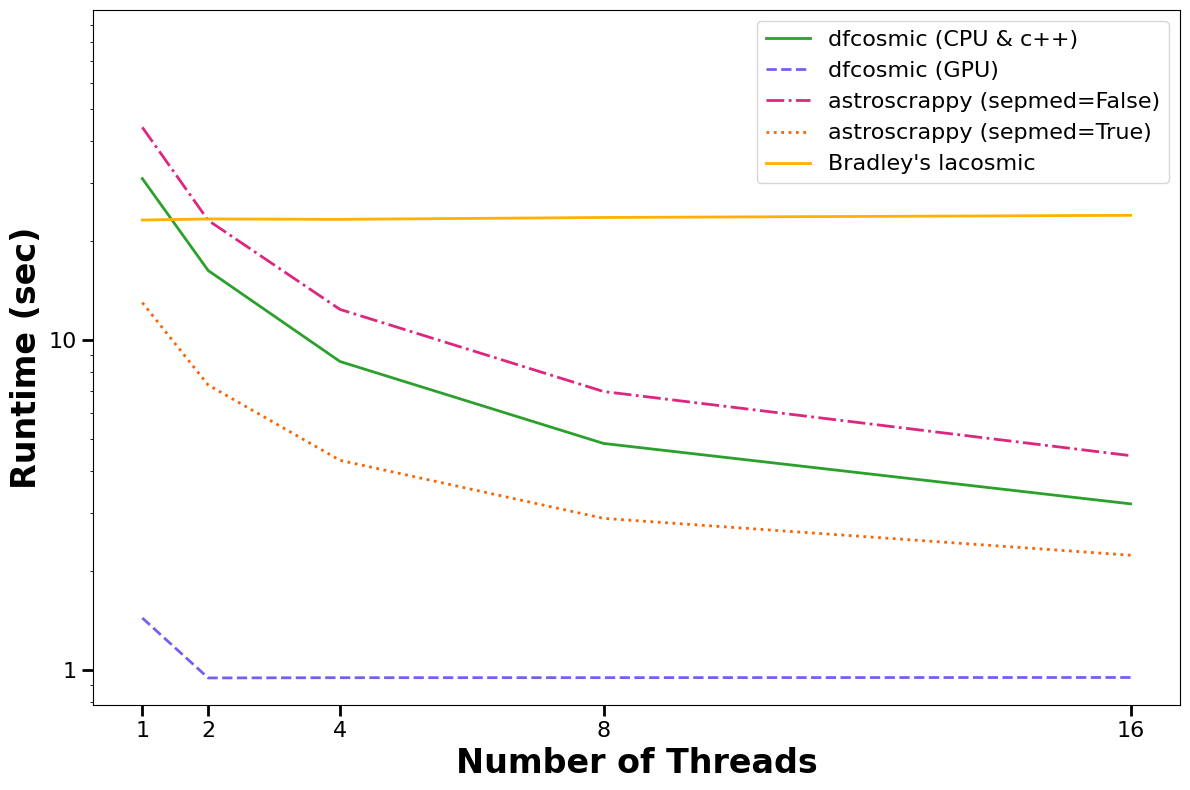
Plot of times
The plot will be broken down in the following manner:
the x-axis shows the number of available threads
the y-axis is the execution time in seconds
the color indicates the option
[11]:
colors = [
    "#2CA02C",  # Green
    "#0B47DF",  # Blue
    "#785EF0",  # Purple
    "#DC267F",  # Magenta
    "#FE6100",  # Orange
    "#FFB000",  # Yellow
]

fig = plt.figure(figsize=(12, 8))
plt.plot(
    num_threads,
    dfcosmic_cpu,
    label="dfcosmic (CPU & c++)",
    c=colors[0],
    linewidth=2,
    linestyle="-",
)

# plt.plot(
#     num_threads,
#     dfcosmic_cpu_torch_only,
#     label="dfcosmic (CPU)",
#     c=colors[1],
#     linewidth=2,
#     linestyle="-",
# )

plt.plot(
    num_threads,
    dfcosmic_gpu,
    label="dfcosmic (GPU)",
    c=colors[2],
    linewidth=2,
    linestyle="--",
)

plt.plot(
    num_threads,
    astroscrappy_sepmed_false,
    label="astroscrappy (sepmed=False)",
    c=colors[3],
    linewidth=2,
    linestyle="-.",
)

plt.plot(
    num_threads,
    astroscrappy_sepmed_true,
    label="astroscrappy (sepmed=True)",
    c=colors[4],
    linewidth=2,
    linestyle=":",
)

plt.plot(num_threads, lacosmic_results, label="Bradley's lacosmic", c=colors[5], linewidth=2)

plt.xlabel("Number of Threads", fontweight="bold", fontsize=24)

plt.ylabel("Runtime (sec)", fontweight="bold", fontsize=24)

plt.legend(fontsize=16)
plt.yscale('log')
ax = plt.gca()


ax.set_xticks([1, 2, 4, 8, 16])
ax.set_yticks([1, 10])
plt.ylim(0, 100)
ax.set_yticklabels(["1", "10"], fontsize=16)
ax.tick_params(axis="both", which="major", labelsize=16, length=8, width=2)

plt.tight_layout()
plt.savefig("comparison.png", dpi=300)
/tmp/ipykernel_9215/2259021377.py:69: UserWarning: Attempt to set non-positive ylim on a log-scaled axis will be ignored.
  plt.ylim(0, 100)
[ ]: